Oil and Gas Wastewater Treatment

Oil and Gas Wastewater Treatment

Oil and Gas Wastewater Treatment

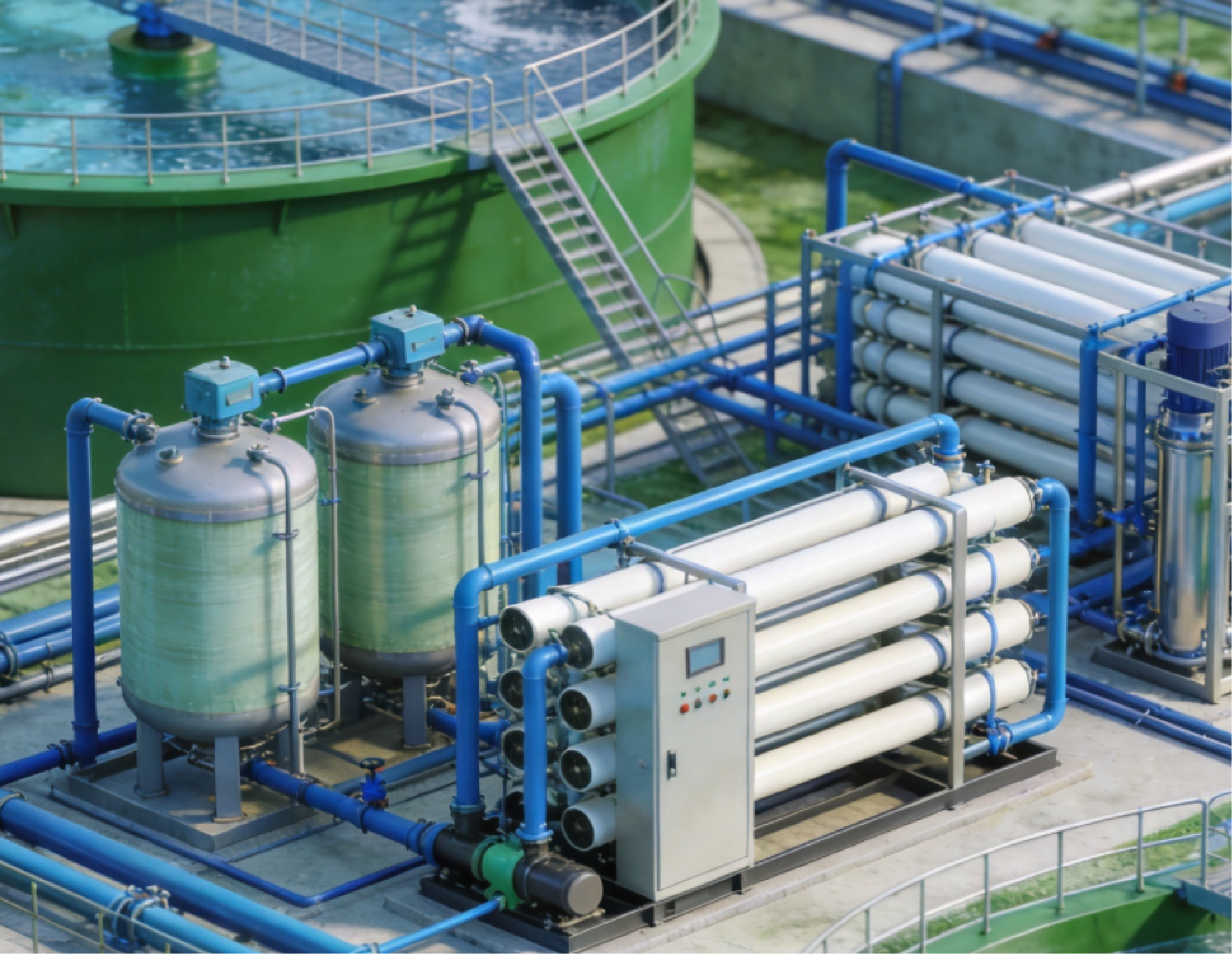
The core of the scheme adopts the natural osmotic pressure difference-driven separation principle. The entire process operates at normal temperature and near normal pressure without pressure. No high-pressure booster equipment is required. This is completely different from the traditional pressure-type membrane filtration process. By relying on the concentration difference on both sides of the membrane to drive water molecules to spontaneously pass through the high-precision reverse osmosis membrane, it can efficiently and stably retain pollutants such as emulsified oil, suspended impurities, high-molecular polymers, colloidal asphalt, calcium and magnesium hardness, high-concentration salts, sulfides, and heavy metals in oil and gas wastewater. It completely eliminates the problems of oil film adhesion, pollutant compaction, irreversible fouling and scaling failure caused by forced squeezing of high-pressure membranes in the traditional process. The system has extremely strong resistance to oil, high salt, complex organic matter, and water quality fluctuations. It can perfectly adapt to intermittent drainage in oil and gas fields, centralized drainage during fracturing operations, and harsh working conditions with large fluctuations in water quality and quantity. It can maintain stable permeation flux and separation accuracy over a long period of time.
Oil and Gas Wastewater Treatment

Project Details

Performance parameters

Inflow water source Tian Cai's water discharge, fracturing flowback liquid, drilling wastewater, gas field wastewater, and well cleaning comprehensive wastewater
Inflow salt content (Total Dissolved Solids) 10,000 - 200,000 mg/L, suitable for ultra-high salinity formation wastewater
Inflow oil content ≤500 mg/L (The pre-treatment can be adjusted to adapt to high oil content shock conditions)
Running water temperature 10 - 45℃, optimal operating condition is 20 - 35℃, suitable for the seasonal temperature fluctuations in the wild.
System comprehensive recovery rate 82%~94%
Overall removal rate of oily pollutants ≥99.5%
The COD (Chemical Oxygen Demand) retention rate of refractory organic substances ≥97.0%
Stable membrane flux operation 6 - 20 LMH (stable flow rate under complex oil and gas conditions)
Operating mode Constant temperature and pressure-free permeation drive, without high pressure, no phase change, no high-temperature heating, and no pressure adsorption contamination

Process Advantages

No pressure

Without pressure adsorption, it completely eliminates the irreversible clogging of membranes by oil stains. From a fundamental perspective, it solves the problem of permanent clogging of viscous oil stains in oil and gas wastewater, and does not require a complex pre-treatment system at the front end. The flux remains stable over a long period.

Tolerant to combined pollution with high COD, high oil content and high salt concentration

Superior anti-emulsification pollution resistance, suitable for extremely complex water quality, tolerant of high COD, high oil content, and high salt combined pollution. The anti-water quality shock capability far exceeds that of traditional membrane processes. The effluent indicators remain stable throughout the year, and the produced water quality is higher, allowing for direct reuse.

High retention rate

It has an extremely high retention rate for pollutants that are difficult to degrade, such as benzene series compounds, phenols, polycyclic aromatic hydrocarbons, and residual additives. No complex pre-treatment is required and it is not prone to pollution.

Unpressurized and low-temperature operation

Operates at normal temperature and low pressure with no external pressure, featuring significant energy-saving advantages and simple pre-treatment.