Lithium Extraction from Salt Lakes

Lithium Extraction from Salt Lakes

Lithium Extraction from Salt Lakes

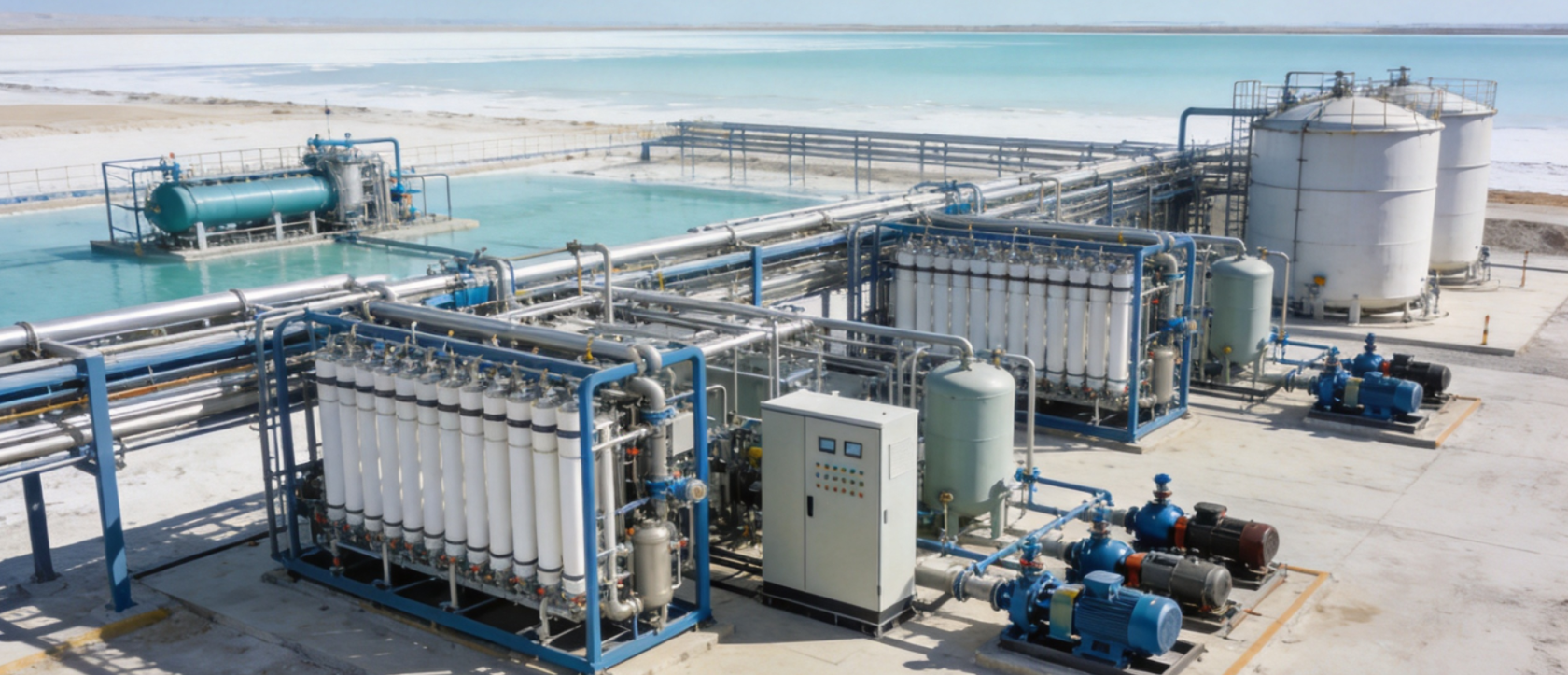
The core of the scheme adopts the natural osmotic pressure difference-driven forward osmosis separation technology. The entire process operates at normal temperature and near normal pressure without pressure, and no high-pressure equipment is required. By utilizing the concentration difference between the high-permeability drawing fluid and the salt lake brine, water molecules spontaneously pass through the high-precision forward osmosis membrane. While effectively retaining magnesium ions, calcium ions, salts, colloids and impurities, it also enables continuous concentration of the brine and efficient enrichment of lithium ions. This technology fundamentally solves the problems of high-pressure compaction causing blockage, salt crystallization blocking the membrane, and rapid flux attenuation in traditional pressure membrane processes. It has excellent resistance to high salt content, anti-scaling, and ability to withstand complex water quality impacts. It is particularly suitable for scenarios of deep concentration and enrichment of high magnesium and lithium ratio salt lake brine, low-grade tailings brine, and old brine residue liquids.

Lithium Extraction from Salt Lakes

Project Details

Performance parameters


Inflow water source Salt lake raw brine, salt lake old brine, lithium extraction tail brine, high mineralization degree lithium-rich brine
Total dissolved solids (TDS) of incoming water 50,000 - 150,000 mg/L extremely high salinity
Running water temperature 10 - 38℃, optimal operating condition is 18 - 32℃, capable of withstanding low-temperature fluctuations at high altitudes
System lithium resource recovery rate 4 to 10 times, the enrichment concentration can be adjusted stepwise as needed
Total salt retention rate ≥99.3%
System comprehensive water recovery rate 80%~93%
System comprehensive recovery rate 65% to 80%, higher than the traditional seawater RO process
Magnesium-calcium ion separation ≥98.5%
Stable membrane flux operation 7 - 19 LMH (standard salt lake brine conditions)

Process Advantages

Resistant to extremely high salt and high magnesium levels, with strong anti-fouling ability

Resistant to extremely high salt and high magnesium content, with strong anti-scaling and anti-pollution capabilities. Suitable for salt lakes with high magnesium-to-lithium ratio and high mineralization degree brine. The membrane surface has no high-pressure adsorption effect, and is not prone to the growth of scaling or adhesion of impurities. It breaks through the osmotic pressure limit, has an extremely high concentration ratio, and can continuously concentrate ultra-high salt brine from salt lakes at a high ratio, rapidly increasing the lithium liquid concentration and significantly reducing the lithium extraction cost.

Long membrane lifespan

The membrane has a long service life, requiring replacement every 2-3 years. Its lifespan is more than three times that of reverse osmosis membranes. Moreover, the system's reabsorption liquid can be obtained locally and does not require special preparation.

Low-voltage operation

The entire system operates at low pressure, and all system components are at low pressure (electricity, pipelines, etc.). The investment in auxiliary equipment has been reduced.

Low energy consumption

The energy consumption is extremely low, being 10% of that of the traditional reverse osmosis treatment method and 2% of that of the traditional evaporation treatment method. The overall cost has been reduced.